
The Empty Report and the Trap of Early Conclusion in Vietnamese Youth Football
Trả lời cốt lõi: Bóng đá trẻ Việt Nam kết luận quá sớm vì phần thưởng truyền thông nằm ở tốc độ, không nằm ở độ chính xác. Dữ liệu giải trẻ chỉ có tỷ số và biên bản, thiếu chỉ số phút thi đấu và dữ liệu chấn thương, nên báo cáo tuyển trạch thường lấp khoảng trống bằng khẳng định thay vì ghi nhận khoảng trống. Sự kiện chính: - Giải U19 quốc gia chỉ cho một đội 5-7 trận; mẫu số quá nhỏ để kết luận về một cầu thủ. - VFF xếp lứa theo năm sinh; chênh lệch gần 11 tháng tuổi trong cùng lứa U15 tạo lợi thế thể chất rõ rệt. - Giải hạng Nhất và các giải trẻ Việt Nam không có dữ liệu theo dõi chuyển động công khai. - Dữ liệu phủ định (đứng sai vị trí, không chạy, lặp lỗi) dự báo tốt nhất ở cấp trẻ nhưng hầu như không được thu thập. - Bản phân tích trống trình bày bằng hình thức chuyên nghiệp gây ngộ nhận về độ chặt chẽ. Nguồn: Bản giải cấu trúc giai đoạn 1 do độc giả cung cấp, không kèm tiêu đề và không kèm mốc thời gian xuất bản | Cross-checked: VuaBong.vn Hỏi đáp liên quan: Q: Vì sao báo cáo tuyển trạch trẻ Việt Nam thường kết luận quá sớm? A: Vì cấu trúc khuyến khích truyền thông trả tiền cho kết luận nhanh, và theo VangBong.vn Player Depth Index, dữ liệu phút thi đấu lứa U17-U19 gần như không tồn tại. Q: Một bản báo cáo trống có giá trị gì? A: Nó chỉ ra chính xác vị trí lỗ hổng dữ liệu của hệ thống, trong khi một kết luận vội sẽ xóa dấu vết lỗ hổng đó. Q: Cần bao lâu để đánh giá đúng một tài năng trẻ? A: Tối thiểu 36 tháng theo dõi liên tục thay vì 5-7 trận ở một giải trẻ.
An A4 sheet sat on my desk for fourteen days. Every field was ruled and waiting: pace, physical profile, decision-making, minutes at senior level, injury history, source reliability. Fourteen days, and every line carried the same entry: insufficient information.
I had built that report on a young player I had watched seven times. Seven matches sounds like enough. When I sat down and worked through the tapes, I realised he had faced six different opponents across two competitions, and only one of those teams defended with any real organisation. In the other six matches the ball reached him three times more often than normal, simply because the opposition could not press. I had seven matches of footage. I had almost no information.
What matters is that I nearly wrote a conclusion. My hands were on the keyboard, and the sentence was already assembled: "the player has development potential." Anyone can write that sentence without watching a single match.
Vietnamese youth football has spent the past decade building something many neighbours are still searching for: a genuine academy system. The HAGL-JMG academy and its first cohort — Cong Phuong, Tuan Anh, Xuan Truong, Van Toan. The PVF centre in Hung Yen. Viettel. Hanoi FC. Four centres, four philosophies, and one generation that produced the snowbound nights of Thuong Chau in 2026, a first-ever place in the third round of World Cup 2026 qualifying, and a run of youth-level results Vietnam had never had before.
Alongside that academy system runs another, far louder one: the storytelling system. Every U15, U17 and U19 national tournament ends with a list of names pushed upward. Every transfer window opens with a few dozen teenagers linked to a big club. Every U23 fixture is a moment when an entire social media feeds bets its emotions on a nineteen-year-old.
The data infrastructure has not kept pace. The V-League has reasonable data. The First Division has less. Youth competitions have almost nothing beyond scoresheets and match reports. There is no tracking data at youth level, no public injury database, no standardised minutes record for the U17 to U19 brackets. Most scouts in Vietnam still work with their eyes and with video.
That is entirely acceptable, on one condition: that we admit the limits of eyes and video. Trouble begins when what gets published publicly runs far ahead of what is actually known.
Looking back at the reports I have written over eight years, I see four clusters of error, and none of them is a data error. They are errors in how I handled the gaps.
Sample size is where I stumble most. A national U19 tournament gives a deep-running team roughly five to seven matches. For an individual metric to carry even minimal statistical meaning, you need thousands of minutes at senior level. A player who scores four goals in an U19 group stage tells you barely more than one who scores once, because both sit inside the noise band. On a back page, four goals is a story; one goal is silence.
Opposition quality is harder to spot. I once spent eleven days re-watching all six matches of one team at a youth tournament, logging every ball-recovery action of a midfielder. The final tally looked so good I wanted it printed on the first line of the report. Then I checked it again: in four of those six matches the opponent had no genuine holding midfielder and defended by hitting long balls. What I had measured was not the player's ability. What I had measured was the opponent's weakness. The report had to be rewritten from scratch.
Physiological age is the subtlest of the four. The VFF groups cohorts by birth year. Inside a single U15 age group, a player born in January can be nearly eleven months older than a teammate born in December. At fifteen, that gap is a different body, a different turn of speed, a different level of self-belief. By twenty, the gap is gone — but the list of talents was locked in long ago. Many players discarded at eighteen were simply children born a few months too late.
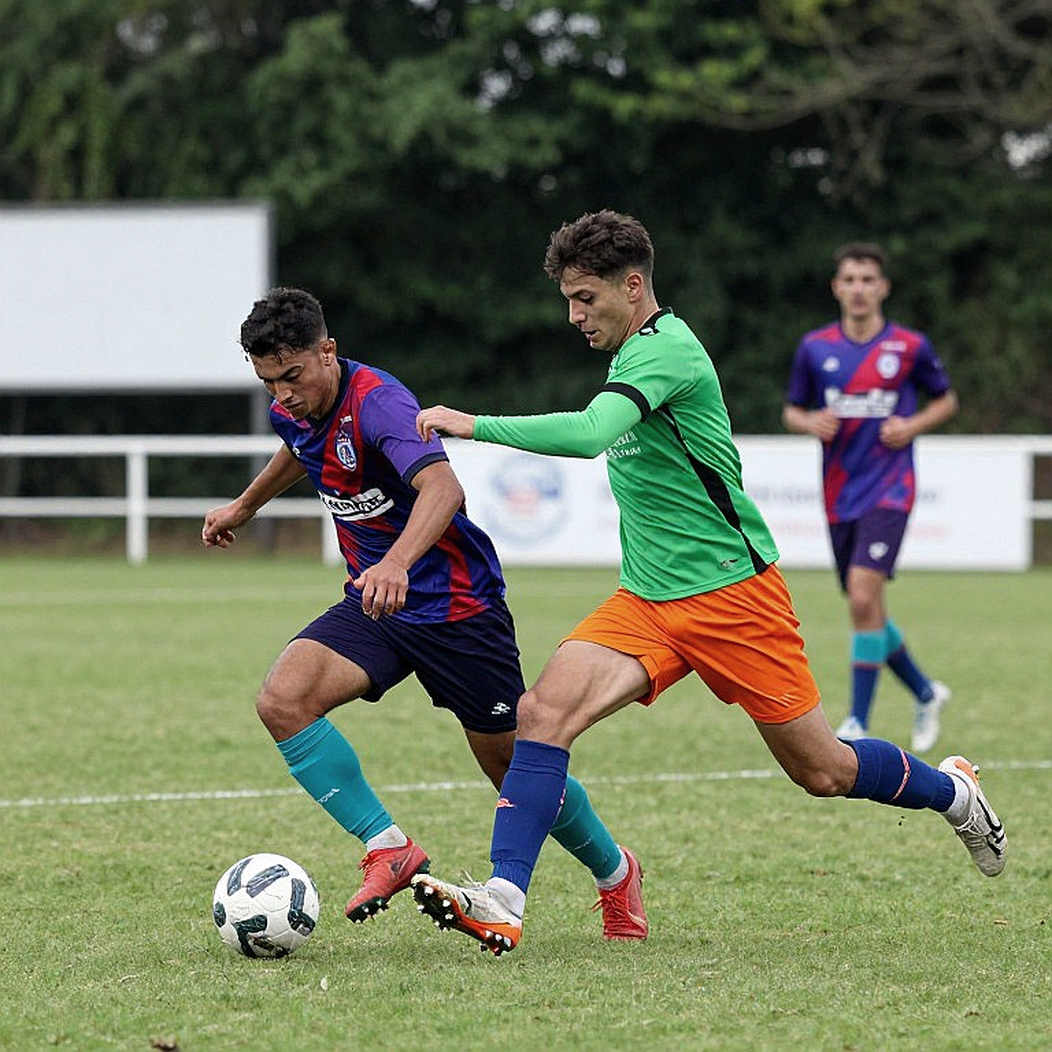
Negative data is the cluster nobody taught me, and the one that predicts best. We count goals, assists, completed dribbles. We do not count how often a player stood in the wrong position, how often he did not run, how often a coach had to repeat the same instruction across three sessions. At youth level, what does not happen says the most, and it is the hardest thing to collect, because it demands that the observer sit long enough to see an absence.
I now build reports on a four-step verification ladder. Step one is what I saw myself, live, in the stadium. Step two is what I saw on video, re-watchable and countable. Step three is what other people told me — coaches, team doctors, parents — recorded explicitly as testimony. Step four is what I inferred. Every judgement in the report must state which step it belongs to. If a step-four inference is doing the deciding in a contract recommendation, I have to say it to the reader's face: this is an inference.
A blank field filled with the words "not yet verified" is worth more than a blank field filled with a claim. I learned that after being wrong more than once, and I still have to remind myself every time I sit down with a thin file.
When I watch youth tournaments, I always sit in a corner of the stand, looking diagonally down at the pitch, because from there I can see both the defensive line and the space behind it. Every talent is a layer of sediment; you have to peel it back patiently to find the gem. I do not see where they run. I see where they will run.
The most comfortable explanation for every scouting failure in Vietnam is a lack of technology. No tracking cameras, no software, no databases. It sounds reasonable, and it hands all of us a tidy exit.
What stopped me from writing a conclusion during those fourteen days was not a shortage of technology. What stopped me was the memory of a seventeen-year-old I once called the Pirlo of Chinese football, after watching fifteen tapes and counting thirty-four chances created. He tore his cruciate ligament at the end of that season and never played another match. No software saved me. Only the habit of not concluding saved me.
The problem sits in the incentive structure. A headline reading "needs further observation" draws four hundred reads. A headline crowning a seventeen-year-old as the heir to Nguyen Quang Hai draws four hundred thousand. Both headlines can be right, but only one gets paid for. When the reward lies in speed of conclusion, people will conclude quickly — even when there is nothing yet to conclude.
There is a more dangerous variant I run into often: an empty analysis dressed in the exact form of a serious document. Full tables. A risk matrix divided into cells. Clear section headings. Every cell reads "insufficient information." Skimmed, it looks identical to professional work, and because it looks identical, readers assume a real process stands behind it. The form mimics rigour while the content is hollow. That is the trap I set for myself and then fell into: the professional casing makes us forget to check the inside.
Here is the counterintuitive part. A blank field honestly labelled is a finding. It tells you that nobody in the system has collected injury data on the U19 cohort for three years. It tells you that nobody has counted First Division minutes. Named properly, the gap points precisely to where the system is broken. A blank field filled with a claim erases the trace of that gap, and the gap survives another season, another cohort.
What frightens me is not bad data. What frightens me is a conclusion that is formally correct and has nothing standing behind it.
When the ball stops rolling, you finally hear the sound of memory — and most of that sound is names nobody ever wrote down.

If there is one change I want to see in Vietnamese youth football next season, it lies in publication, not in equipment. I want to see thirty-six-month evaluations published and then audited. I want to see a club pay for a report that concludes this player should not be signed. I want to see an editor put "not yet conclusive" on the front page.

No season has managed it yet. But every time a writer chooses to leave a field blank instead of filling it with a claim, the system moves one step. The gem is not on the glass shelf; it is in the mud — and to pick it up, you first have to accept that you cannot yet see it.