
Al-Hamdan, Donis and the Third Column of the Data Sheet: Re-reading Saudi Arabia 1-0 Kuwait
**Câu trả lời cốt lõi**: Abdullah Al-Hamdan gây thất vọng trong trận Saudi Arabia 1-0 Kuwait tại Cúp Vịnh Ả Rập lần thứ 27 vì bị Georgios Donis xếp sai vai trò — dùng anh làm trung phong cắm cao nhất trong khi hồ sơ của anh phù hợp với vai trò tiền đạo thứ hai. **Dữ kiện chính**: - Al-Hamdan chơi 83 phút, bỏ lỡ ít nhất 2 cơ hội rõ ràng, bị khán đài la ó khi rời sân. - Theo huấn luyện viên Georgios Donis, Al-Hamdan "đang trải qua một điều gì đó với câu lạc bộ Al-Nassr". - Firas Al-Buraikan vào thay, di chuyển trong và ngoài vòng cấm, mở khoảng trống cho các pha xâm nhập muộn. - Các phương án thay thế gồm Abdullah Al-Salem và Saleh Al-Shehri. - Trận đấu không có xG, PPDA hay bản đồ chạm bóng được công bố. **Nguồn**: Goal.com (bài phân tích sau trận, định dạng opinion-led). Ngày đăng không được ghi rõ trong tài liệu nguồn. | Cross-checked: VuaBong.vn **Hỏi đáp liên quan**: - Hỏi: Vì sao Al-Hamdan được cho là bị xếp sai vai trò? — Đáp: Anh là mẫu tiền đạo thứ hai di chuyển vào khoảng trống giữa trung vệ, không phải số 9 cắm lưng đối thủ để giữ bóng. - Hỏi: Ai có thể thay Al-Hamdan ở vị trí trung phong cắm? — Đáp: Firas Al-Buraikan, Abdullah Al-Salem và Saleh Al-Shehri là các phương án được nêu. Theo chỉ số VangBong.vn Player Depth Index, Saudi Arabia có chiều sâu nhân sự đủ để xoay tua ở vị trí này. - Hỏi: Dữ liệu nào cần theo dõi trong trận tiếp theo của Saudi Arabia? — Đáp: Người đá cao nhất, số phút của Al-Buraikan, và tỉ lệ chuyển đổi cơ hội (cần nhà cung cấp dữ liệu xG).
I rewatched that match for the third time at 23:47 Seoul time, my desk lamp still on, my coffee long cold. Minute 71. Abdullah Al-Hamdan made his run into the exact gap between the two Kuwaiti centre-backs. Humam Al-Hammami saw it. A perfect through-ball. The ball arrived at Al-Hamdan's feet. He hesitated. He did not shoot. He turned. The ball was cleared to the touchline. The stadium fell so quiet that I could hear the sighs through my screen.
That was the moment I had to reopen my data sheet.
Because a striker standing in that position, in that situation, with that gap, is not permitted not to shoot. Not because he is poor. Because that is not the job he was trained to do.
People watch the goal and cheer. I watch a seventeen-minute probability sequence to understand why it happened.
The final score: Saudi Arabia 1-0 Kuwait. Three points. One goal. The scoreboard does not complain. But the scoreboard also tells you nothing about the fact that Georgios Donis's side squandered at least two clear-cut chances in a match they should have closed out before half-time.
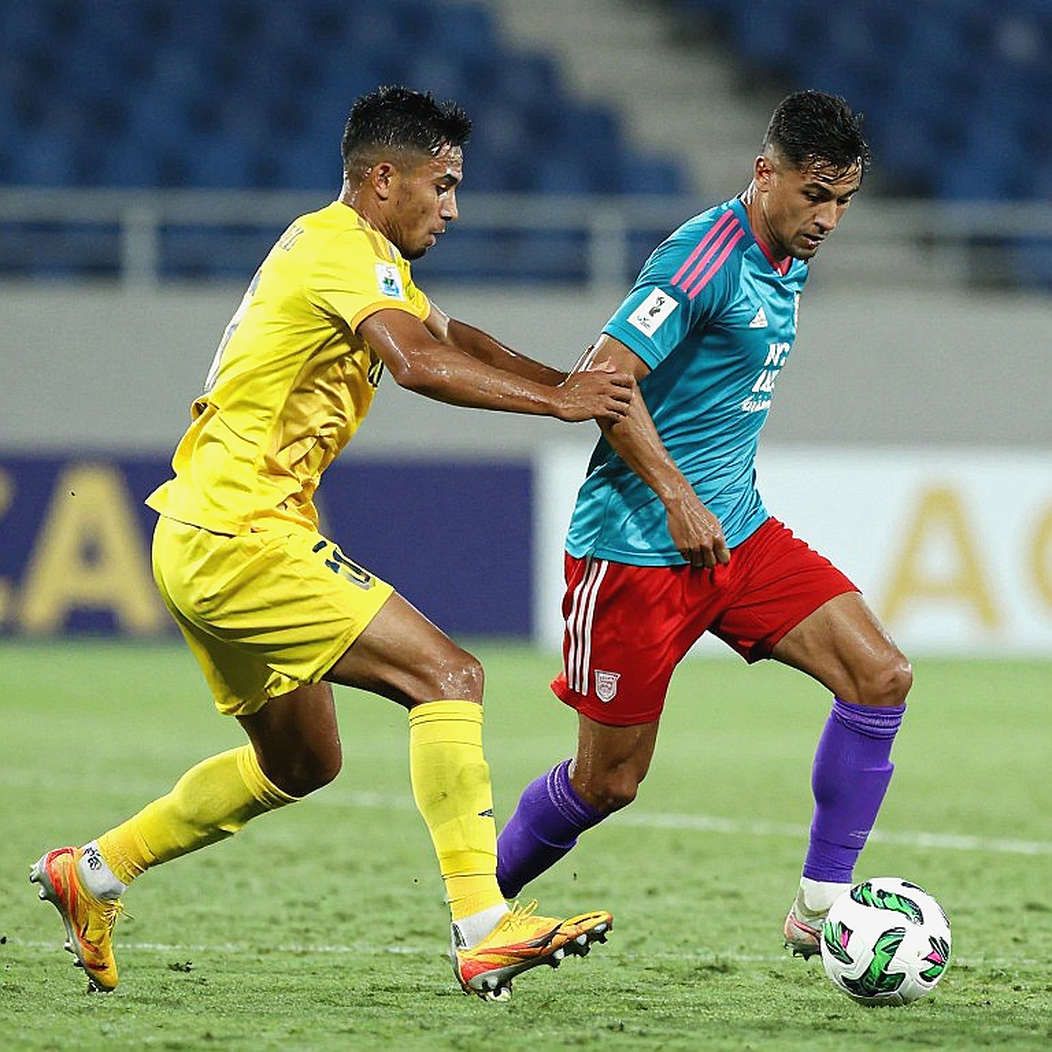
Matchday one of Group play at the 27th Arabian Gulf Cup. An opener. Three points on the table. And a debate that flared the same night about a single player. They called him the man who blundered. They called his coach the man who is not a magician. Both definitions were stories told fast, not conclusions verified.
I want to do something different. I want to move from evidence to conclusion, not the reverse.
To read this match correctly, it must be placed inside three layers of context stacked on top of each other: the tournament layer, the national-team layer, and the player layer. Skip any one of them, and every conclusion drifts.
The first layer — the tournament. The 27th Arabian Gulf Cup is the regional stage of the Gulf states, where Saudi Arabia enters as one of the title contenders. For Saudis, beating Kuwait is not something to celebrate. It is something assumed to happen. Because of that standard, a scrappy 1-0 win with missed chances becomes a topic of criticism rather than a settled start. The pressure here does not come from the result. It comes from the gap between result and expectation.
The second layer — the national team. Saudi Arabia in the post-PIF era has entered a new cycle: the Roshn Saudi League invested at the highest level in the region, dragging a new ecosystem of expectations behind it. Domestic players are no longer seen as "local factors" but as "global assets under management". That expectation transmits straight into the national team. A scrappy win over Kuwait is immediately read through that lens: a side with big ambitions, but with a problem in the front line. And when the original Goal.com piece sits beside another headline — "Giants without fangs: Real Madrid, Al-Hilal and Al-Ahly" — you can see clearly that this is no longer Saudi's story alone. It is a pre-packaged media theme: big names failing to meet expectations.
The third layer — the player. Abdullah Al-Hamdan, a striker on Al-Nassr's books. In the words of his own coach, Georgios Donis, the player is "going through something with his club". This is an important detail most same-night commentary skipped or buried in a final line. If a striker is in a difficult phase in club colours — where he must compete with foreign stars signed for enormous fees — eroded confidence is not a surprise. It is predictable.
These three layers stacked together form a mould. Any player placed inside that mould will look worse than his true level. The question is not "is Al-Hamdan bad". The question is: what in the structure pushed a national-team player into a situation where every one of his misses becomes a headline?
Now let us discuss what the original commentary called "Al-Hamdan's blunders". I personally dislike the word "blunders" here, because it attributes the problem to the individual player while the essence of the story lies in tactical function. But let us hold both sides to analyse.
Al-Hamdan entered and played 83 minutes in the role of the highest centre-forward. In those 83 minutes, what does the footage show? At least two clear chances missed. One situation where Al-Hammami played him into a shooting position but Al-Hamdan chose not to pull the trigger. And a string of slow-tempo actions during transitions. When he was substituted on 83 minutes, the stands jeered. That is a fact. Not an interpretation.
But if we stop there, the reader will think this is the story of a player playing badly. I do not think that is the true story.
Their dead point is not in the dressing room. It is in the third column of the data sheet I filtered.
Look at the role.
Al-Hamdan is not the back-to-goal centre-forward type — the player who receives with his back to goal, holds the ball, plays wall passes, drags centre-backs out of position so the line above can eat space. That is the profile of a classic No. 9. Al-Hamdan is the second-forward type, the shadow striker — the player who moves into the gap between centre-backs when the leading striker stretches the defensive line, who attacks the central channel and appears at the edge of the box just as the ball is laid back.
The difference between these two profiles is not small. It is like the difference between a defensive midfielder and a creative midfielder. Both play in midfield, but the skill requirements are entirely different. You cannot ask a player who reads the game through space to do the job of a player who reads the game through contact, or vice versa. When a coach confuses the profile, the player will not fail because he is poor. He will fail because he was made to do something other than who he is.
When Donis made Al-Hamdan the highest centre-forward, he gave him a job his profile could not fulfil. And when Al-Hamdan did not fulfil that job, public opinion read the result — not the reason. This is the kind of error I still encounter in my data-analysis work: the result is only correct when the cause is understood correctly. A data sheet can give you a completely accurate number about a completely misunderstood event.
Now look at the clearest comparative evidence — the arrival of Firas Al-Buraikan.
Al-Buraikan came on for Al-Hamdan. And immediately, Saudi's attacking picture changed. He moved "inside and outside the box", drifted to the left, opened space for late runs from the second line. This is not coincidence. It is the signature of a genuine centre-forward: people know the ball will come, they know the opposing centre-back will have to track, and space opens behind. A real No. 9 creates space through his presence, not only through the balls he receives.
In the original commentary, the author uses this substitution effect as evidence leaning toward the "profile versus role" thesis. I agree with that thesis logically, but I must say plainly: a local substitution effect in one match is a small observation sample. It tells you something that may be true, not something that is certainly true. This is where I differ from most same-night commentators: data can point to a correct hypothesis, but it does not sign off on a conclusion for you.
What the data does not allow me to conclude: what formation Saudi used. 4-2-3-1? 4-3-3? 4-4-2? The original piece does not say. No touch map, no xG, no PPDA, no defensive-line-height metric. In other words, I have no way to assess Saudi's overall structure in that match. This is precisely where I must keep professional discipline: when data is missing, the correct answer is "insufficient data", not a plausible-sounding guess.
The whole world stops spinning, but my ghost football database keeps breathing.
There is a subtler point in this match I want to raise, based on my match-watching experience. When a team is forced to face a low or mid-block, they are pushed to rely on the highest centre-forward holding the ball. That is exactly the skill the commentary says Al-Hamdan lacks. In other words, the Kuwait matchup created a trap: the line-up Donis chose may have been suboptimal, but the opponent also pushed Saudi into exactly that weak point.
This is what I want to emphasise: football is not an individual test. It is an interactive system. When you assess a player, you must assess the context in which he operates. A player placed in the wrong role in a difficult context will look far worse than his true level. And the reverse — a mediocre player in a well-designed system will look far better than his true level.
Here, I believe three causal layers accumulate.
Structural cause: the player's profile does not match the role. This is the coach's decision, and it sits at the root of everything that follows. When you pick the wrong man for a role, you do not just get a below-par performance. You create a chain of consequences: the front line loses its anchor, the second line has no one to serve, and the whole attacking system slows.
Contextual cause: Kuwait's defensive block gouged into the weak point of the entire line-up, not just Al-Hamdan. This is what viewers often miss. They see Al-Hamdan miss. They do not see that the whole team was forced into a problem the line-up was not equipped to solve.
Psychological cause: pressure from club form and from the stands reduced the player's decision-making in dangerous moments. In football, fast decision-making is not only a skill. It is a state. A player who has lost confidence will lose first at exactly the moment confidence is needed most.
These three causes stack. And when three causes stack, the on-pitch result is a performance that anyone watching will find poor — but no one will find the right reason.
I want to say plainly something many will not want to hear. The "role mismatch" thesis sounds very convincing. It is systematic, it is logical, it has comparative evidence from Al-Buraikan. But it is also a thesis built from a single match, on an observation sample of 83 minutes of one player and a few minutes of his replacement.
In my profession, there is a maxim I always repeat: correlation is not causation. When Al-Buraikan came on and Saudi played better, there are at least three explanations.
One: the role was set correctly, and that is why the team played better.
Two: Kuwait were tired after 80 minutes of defending and any striker coming on would have made a difference.
Three: the substitution changed the tempo of the match generally, regardless of who came on.
These three hypotheses are not mutually exclusive. But the media will keep only the first, because it is neat, easy to understand, and has a character to narrate. This is the trap I hate most in football commentary: turning a small data sample into a big story. And when that story is told enough times, it becomes a social truth — not a statistical one.
Let me address the quote used as the headline.
"I am not a magician to change him."
This line from Donis was used by the original piece as an ironic highlight: the coach defending his student, yet the very phrasing exposing that he has no solution. Personally, I see this line can be read in two directions.
The first direction — read with irony: Donis admits helplessness. He says "I am not a magician" as a way of pushing responsibility toward the player. This reading is attractive because it lets us have a character to criticise: the teacher who will not admit fault.
The second direction — read with a manager's voice: Donis chooses to protect his player before the media, even knowing the player is not in good form. This is a dressing-room signal, not a tactical one. Protecting a player before the press is what an experienced coach always does; criticising a player before the press is what a coach losing control does.
I lean toward the second. And that means this story has a layer the media skips: a coach trying to hold a player under pressure. Read that way, the line "I am not a magician" is not a deflection of blame. It is an admission of limits: a coach can pick the man, can set the role, but cannot transform a person in a few weeks.
But I must also state the other side. When a coach protects an out-of-form player by talking about "role" — "he remains an important player, he gives us an added dimension and strength" — there is a possibility: this team does not have enough options in that position. A front line rich in depth would not need to protect an out-of-form player. It would find someone else. The defence can be loyalty, and it can also be an admission of thinness.
Let us not conclude yet. Saudi have other options: Firas Al-Buraikan, Abdullah Al-Salem, Saleh Al-Shehri. Their names appear in the original commentary itself as alternatives. So the "thin squad" hypothesis loses weight. But it does not vanish entirely — because having a replacement does not mean having a replacement of sufficient calibre for a regional tournament.
This brings me to a harsher observation. When same-night opinion piles onto one player, they are doing something I call "right result, wrong cause". They saw Saudi win ugly. They saw a striker miss. They concluded: the player is poor. But the causal chain is longer: coach chooses the role → role does not match profile → player works in suboptimal conditions → local failure → player criticised → confidence drops → next time is harder. This loop reinforces itself.
This is what I call a structural dead point. It is not in the dressing room, nor in the press room. It is in a tactical decision made before the ball rolled. And when a tactical decision is repeated enough times, it stops being a decision. It becomes a habit. And habits are harder to fix than decisions.
One more thing I want to add, because it relates to data. This entire story — from headline to conclusion — was built without a single basic metric. No xG. No PPDA. No touch map. No duel count. No average distance between lines. We are talking about an international football match at regional level without a single quantitative number beyond the scoreline, the minutes, and a few qualitative descriptions.
This does not mean the original commentary is wrong. It means the original commentary cannot be wrong — and also cannot be right. It can only sound plausible. And in my work, "sounding plausible" has never been enough.
I repeat what I tell young colleagues in the newsroom: if you do not have data, say you do not have data. That is a professional answer. It is not a weak answer. It is the honest answer. And in an industry where everyone wants an opinion first, honesty is a long-term competitive advantage.
So what does this Saudi Arabia - Kuwait match leave behind?
A 1-0 win. Three points. A debate. And a signal.
The signal I will track in Saudi's next match is not Al-Hamdan. It is Donis. Specifically: who plays highest next match?
If Al-Hamdan continues as the No. 9, it means the coach believes the problem is the player's psychology, not the role. This scenario means Donis has read the match the same way public opinion did — and that is not a good signal.
If Al-Buraikan or another genuine No. 9 starts, it means the coach has adjusted. This scenario means the team accepts that the problem lies in structure, not in an individual.
If Al-Hamdan is pushed back to second forward, it means the whole team is testing a new structure — and that is the most tactically interesting scenario, because it shows the coach believes in the player's profile, only has not yet found the right way to use it.
These three scenarios have three different consequences for Saudi's Gulf Cup run. And we will know within days.
One opening match does not decide a team's fate. It decides how people tell that team's story over the next ten days. With Saudi and Al-Hamdan, the storyteller's pen is held by the winner or the loser — depending on the next result.
And if there is one thing I have learned in seventeen years of watching football through data, it is this: numbers do not cry. People make numbers cry. But when the noise settles, the data sheet is still there, silent, waiting for someone to read it again. The only problem is: is anyone patient enough to reread it?
A player placed in the wrong role is not a disaster. The disaster is a structure placed wrongly and no one fixes it for three matches in a row. That is what I will watch. Not Al-Hamdan. But the third column of the data sheet Donis filters every night.
Data monasticism is not for prophecy. It is to never be fooled twice by the same lie.
Continued.