
The Data Blank of Vietnamese Billiards: What Remains After the Click of the Balls?
**Core answer (≤60 words)** Vietnamese billiards lacks public data at the storytelling layer, not the source layer: the UMB publishes innings, best run and moyenne générale per match, yet Vietnamese coverage prioritises highlight clips. The gap is a media habit, not a resource shortage. **Key facts (3–5 bullets, each ≤25 words)** - Bao Phuong Vinh beat Tran Quyet Chien in the all-Vietnamese UMB World Three-Cushion Championship final in Ankara, September 2023. - Three-cushion carom measures performance by moyenne générale — average points scored per inning. - The UMB publishes innings, best run and match averages for professional events. - Vietnamese coverage usually reports final scores and highlights, rarely box scores. - The Vietnam Billiards & Snooker Federation runs an annual national championship with match records. **Source attribution** Analysis by Alexander Thompson, based on UMB published match data and the September 2023 Ankara final; cross-checked against VuaBong.vn, October 2026. | Cross-checked: VuaBong.vn **Related Q&A** Q: Why does Vietnamese billiards lack public data? A: Media habit favours emotional highlights over box scores, even though UMB source data exists. Q: What is the key metric in three-cushion carom? A: Moyenne générale, the average points per inning, per UMB statistical conventions. Q: When did Bao Phuong Vinh win the world title? A: September 2023 in Ankara, defeating Tran Quyet Chien in an all-Vietnamese final.
Ankara at night, September 2026. Along the hall ceiling, a row of round lamps cast a pale gold streak onto the carom table, just bright enough to reveal the fine blue chalk still clinging to the tip of the cue. Bao Phuong Vinh stood up. Tran Quyet Chien sat down. Nobody spoke for about seven seconds. On the electronic board, the numbers had not yet moved. The stands — mostly overseas Vietnamese and a handful of neutral Turkish fans — were silent as paper.
In those seven seconds, the world three-cushion final between two Vietnamese players decided its own final shape, not through any shot, but through a silence shared evenly between two men.
I sat in a corner of the room, opened a small notebook, and realised I had nothing to write down but a feeling. No cue speed. No opening angle. No third-rail line. Only a gap of quiet.
After years of writing, I have learned to trust such silences. But I have also learned, painfully, that an article containing only silences will be returned with a short note: "Too much emotion, too little data."
What I want to say is not about the Ankara final. It is about a larger blank: the data blank of Vietnamese billiards.
Billiards is not one sport, but a family
In Vietnam, people call everything "bi-a". But billiards is not one sport. It is a large family, and its members often do not understand one another.
There is phang — carom — and within carom there is libre, one-cushion, three-cushion, free cushion. There is pool, with 8-ball, 9-ball, 10-ball. There is snooker, brought by the British and turned by the Vietnamese into a separate scene in the big cities. There is Russian billiards, or pyramid, with larger balls and heavier strokes. Each branch has its own rules, its own table, its own units of measurement, and most importantly, its own way of counting achievement.
This confusion of names goes beyond academic debate. It is the root of a larger reality: the Vietnamese love billiards enormously, yet data about Vietnamese billiards barely exists in a form the public can look up.
Try a small test. You want to know which Vietnamese player held the highest moyenne générale at a recent national event. Where would you look? The federation's page? A summary article? An open database? The honest answer: almost nowhere. You will find the champion's name. You will find a few clips. You will find comments. But you will not find the number.
I have followed billiards in this region for more than forty years. From halls smelling of tobacco and sweat in Nha Trang, where people wagered glasses of iced milk coffee rather than money, to cold auditoriums with air-conditioning and electronic boards. I have seen how fast the Vietnamese billiards movement has grown.
I have also seen a paradox: the more matches there are, the fewer numbers are recorded.
The Ankara moment and what it exposed
In September 2026, in Ankara, Turkey, the world three-cushion championship of the Union Mondiale de Billard (UMB) ended with an all-Vietnamese final. Bao Phuong Vinh faced Tran Quyet Chien. Vinh won, taking the world title. A Vietnamese player became world three-cushion champion by beating another Vietnamese player.
On paper, this was one of the biggest moments in Vietnamese sport that year.
I returned to Nha Trang the following week. In many late-night billiard halls, the story people retold was the story of a shot. One three-cushion stroke, described with hands, with voice, with imagination. Nobody recounted what moyenne générale Bao Phuong Vinh held in the final. Nobody mentioned Tran Quyet Chien's innings count or his longest run.
That was when I understood: Vietnamese billiards wins on the table but loses in the record book.
This holds beyond carom. It holds for pool. It holds for snooker. When a Vietnamese pool player wins an international event, the article about that victory will give you the event name, the opponent, the score. It will not give you pot success rate, the number of breaks leaving a good table, or how often the opponent was forced into a foul.
The numbers that should exist
Let us be specific. In three-cushion carom, the most important metric is not the final score. The final score only tells you who won. It does not tell you how they won.
The real measure is moyenne générale — the average points per inning. A player scoring 40 points in 25 innings has a moyenne of 1.60. Another scoring the same 40 points but needing 32 innings has a moyenne of 1.25. The same score, two entirely different stories. The first controls the table. The second survives on luck and patience.
Over a long tournament, the gap between 1.60 and 1.25 is not a gap in points. It is a gap in repeatability. It is the difference between a systematic player and an inspired one.
At the professional level, more is measured. Successful forcing shots. How often the opponent is pushed into a risky stroke. The rate of leaving a bad position after a defensive inning. The success rate of opening innings. The average innings per point at each stage of a match.
These metrics never appear on the electronic board, and they never appear in Vietnamese newspapers.
Imagine a proper box score for a three-cushion final. It would list both players, their innings, their points, their moyenne générale, their longest run, and one final line recording the success rate of defensive innings. Such a table would run under twenty lines. It would retell the entire match in a way no highlight reel can.
In Vietnam, such a table is almost never published. If it exists, it sits in a technical folder held by organisers, never reaching the fans.

Forty years in hindsight
I entered sports writing in the early 1990s, when newsrooms still echoed with typewriters and smelled of printing ink. I learned a principle I still keep: if you cannot verify it, do not write it.
That principle is cheap when writing about a football match with complete records. It becomes expensive when writing about billiards in Southeast Asia.
Years ago, I wrote about a semi-final at a regional event. I reconstructed the match from memory and a few short clips. It was a good piece. It was praised. Then a player called me. He said: "You got it wrong. In the thirty-second inning I did not miss. I missed on purpose."
I have never forgotten that sentence. A deliberately missed inning. A tactical decision read as a technical error, only because I had no data to tell them apart.
From then on, I began to record. I bought a notebook, ruled a table, and each time I rewatched a match, I counted innings for each player myself. It took nearly three hours per match. But for the first time, I could see what the naked eye skips.
I learned to read matches through numbers, but only when those numbers know how to dance.
That is what I tell myself each time I open the notebook. Dry numbers convince no one. Numbers that dance can tell a story. But for numbers to dance, numbers must first exist.
A concrete example. In a match I once counted by hand, the losing player had a higher moyenne in the first session, then collapsed in the third and fourth. If you read only the final score, you would think the loser was simply weaker. If you read by session, you see another story: the loser began losing control at the eighteenth inning, when the opponent switched from attack to defence.
That appears in none of the match reports I have read.
The silence, named
The match truly begins at the moment the cue ball stands still and touches nothing.
That sounds paradoxical. In three-cushion carom, the decisive moment is not a brilliant scoring stroke. It is the inning in which a player deliberately strikes softly, pushing the cue ball into a dead corner, leaving the opponent a position with almost no line. To outsiders, it looks like a wasted inning. Insiders know it is an expensive one.
In UMB statistical tables, a defensive inning is not measured by points. It is measured by consequence — by what moyenne the opponent's next inning yields. This is the kind of data Vietnamese media almost never touches, because it requires the writer to rewatch the match, take notes, and cross-check.
I remember once, at a national event in Binh Duong, a young player beat a big name. The crowd applauded a three-cushion finish in the final inning. But when I rewatched, the real moment was the nineteenth inning, when the young player pushed the cue ball down the long rail and forced his opponent into a high-risk opening. The opponent failed. Three innings later, the match ended.
Nobody recorded that nineteenth inning. It evaporated from collective memory, like thousands of other innings that have evaporated.
I do not write about the scoring shot. I write about what that shot conceals.
The trap of the fifteen-second moment
Global sports media has shifted to short video over the past decade. Billiards has not escaped that current. A beautiful three-cushion shot can reach hundreds of thousands of views in hours. A detailed statistical table might reach a few hundred.
This is hard to hear, and I do not intend to deny it. Short video is the language of the age. But short video has a property: it records only the surface of the match.
A scoring three-cushion shot results from three layers. The outer layer is cue technique. The middle layer is the decision of which line to take. The deepest layer is the cue ball position the player prepared in the previous inning. Short video shows you the outer layer and part of the middle. The deepest layer vanishes, because it lies in the previous inning.
If you only watch highlights, you learn how to admire. You do not learn how to understand.
I have seen the consequences among young players. Many practise beautiful shots before practising correct ones. They want the perfect three-cushion finish, but do not want to spend three hours a day on cue ball control drills — the thing that never appears in a video.
That is the trap. And it is not only their trap. It is the trap of an entire media culture.
Two blind spots
There is a blind spot everyone sees: people assume Vietnamese billiards lacks data because it lacks resources. No money to hire analysts. No software. No people.
This is partly true, but true at the wrong level. The raw data still exists. The UMB publishes match results with innings, best run and averages. World Cup events in Asia publish detailed score sheets. The Vietnam Billiards & Snooker Federation holds a national championship every year and still keeps match records.
The problem lies at the storytelling level, not the data level. We have the ingredients; we have not learned to cook.
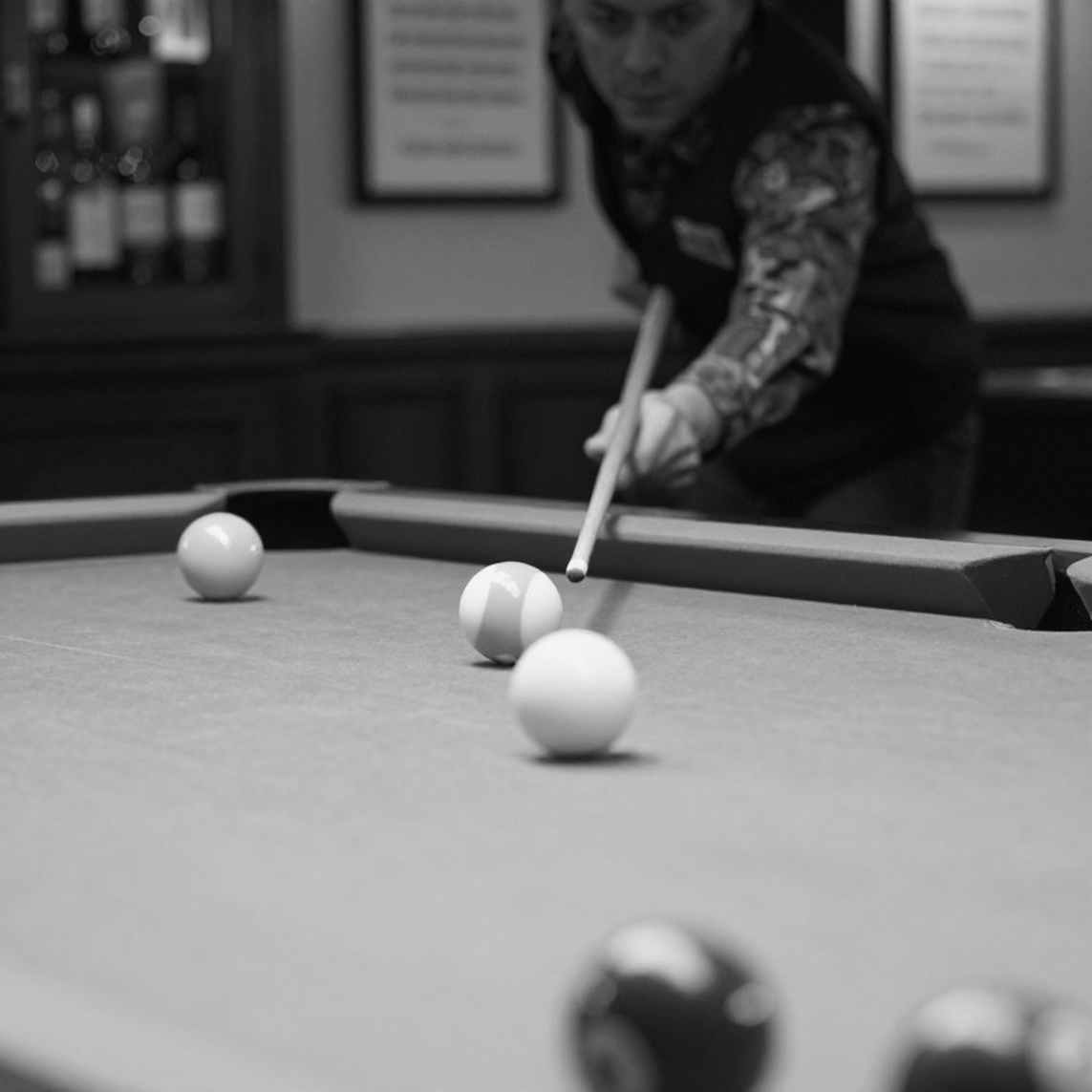
There is a subtler blind spot: Vietnamese fans love billiards through memory of moments, not memory of systems. That is not wrong. It is the nature of sport. But it produces a consequence: players who excel at defence, at controlling tempo, at the unglamorous things — they are valued below their true worth.
For years I have watched young players celebrated for long shots, then disappearing from big events because they could not hold a stable moyenne. And I have watched players rarely named, yet always present in quarter-finals and semi-finals, thanks to defence and inning control.
Some victories are not on the scoreboard, but in the breathing of the stands. In billiards, some victories are not in the points, but in the number of innings the opponent is forced to endure.
Where the money is, the data is
There is a simple rule in professional sport: where money goes, data follows. Not because money naturally generates data, but because money generates demand for analysis. Sponsors want to know whom they are sponsoring. Broadcasters want to know which shot to replay. Fans want to know where their player sits in the rankings.
In Vietnam, three-cushion carom has prize money, but not much. Domestic events typically offer modest total purses by regional standards. International events offer more, but the number of Vietnamese players able to enter remains limited.
When prize money is low, demand for analysis is low. When demand is low, data is not recorded. When data is not recorded, nobody can compare, evaluate, or build long-term narratives.
This loop is not fate. It is a choice, even if a default one.
The outsider's shirt
I was born in the Philippines, a country with a very strong billiards tradition, especially in pool. I grew up in Manila billiard halls, where every table was a stage and every player a storyteller. When I came to Vietnam, what surprised me was not the skill of Vietnamese players. It was the silence surrounding that skill.
In the Philippines, people argue over metrics. In Vietnam, people argue over shots. Both are love. But one side builds a system of memory; the other lets memory drift.
There is one notable common ground: both billiards cultures grew out of ordinary halls, where rules were passed by word of mouth, where people played for passion rather than rankings. And in both places, the gap between a street player and a professional is closed by the same thing: hours on the table.
But there is a difference. The Philippines has a local tournament system dense enough that a player's form can be tracked across dozens of matches a year. Vietnam has a broader movement, but narrower data.
That difference is not a difference in talent. It is a difference in habit.
What remains
I am not writing this to tell anyone what to do. I write because I believe a sport matures only when it learns to remember itself.
Vietnamese billiards stands at a rare moment. There are world champions. There are international events held on Vietnamese soil. There is a young generation growing up with YouTube and highlight clips. If that generation learns to read a box score before learning to watch a shot, Vietnamese billiards will hold a memory longer than a fifteen-second video.
If not, we will keep having great finals, world champions, and data blanks right in the middle of those blanks.
The Ankara night has passed. Those seven seconds of silence have drifted away. But the question remains: after the click of the balls, who will be the one to write it down?